
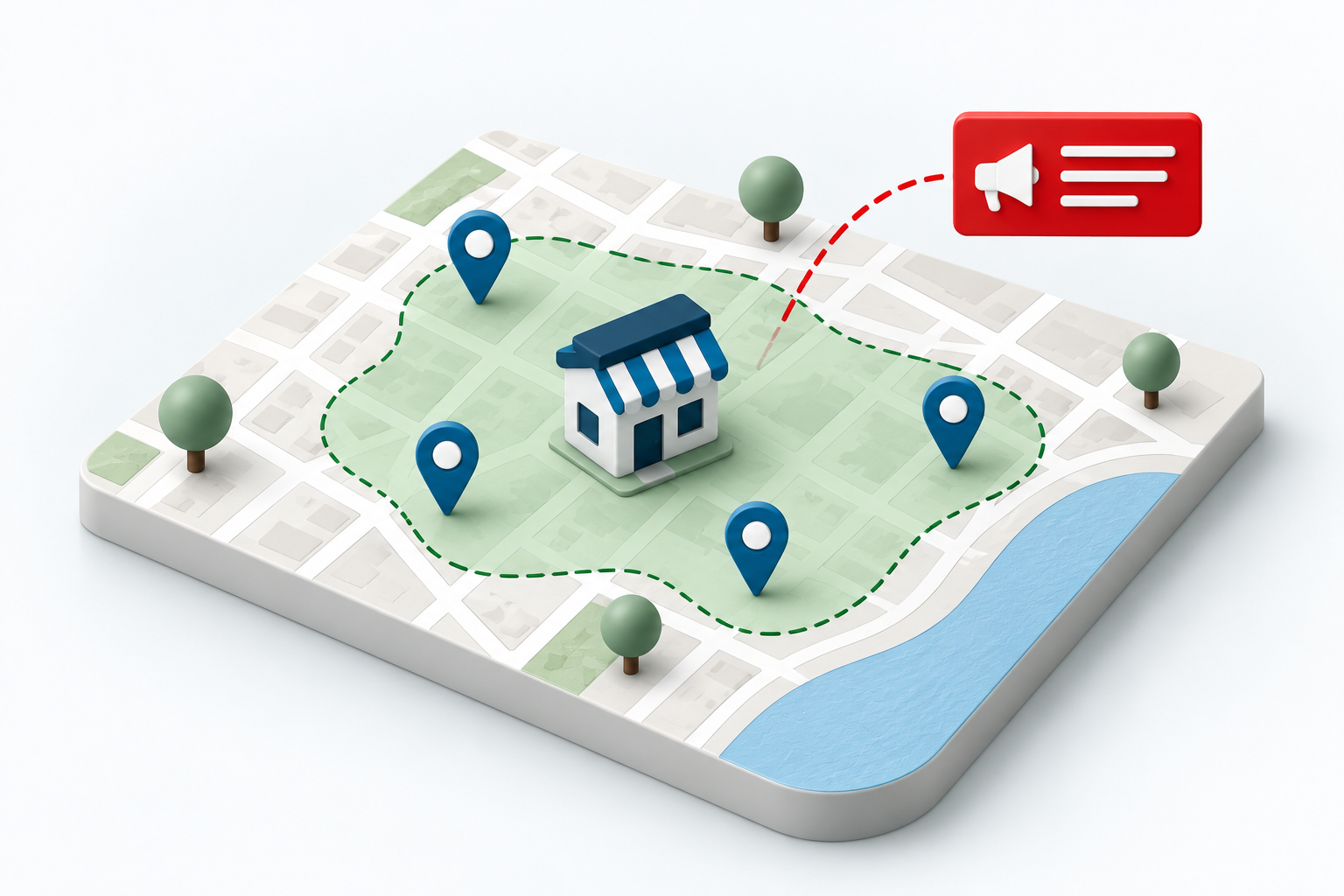
For some businesses, a potential customer’s location is central to whether an enquiry becomes useful business.
A contractor needs enquiries from areas their team can serve. A retailer needs customers willing to visit its stores. A regional supplier needs to reach buyers within its delivery network.
Location-based advertising helps businesses focus paid campaigns on the places that matter commercially. Its value comes from connecting geography with a relevant offer, a clear next step and a way to measure what happens afterwards.
What is location-based advertising?
Location-based advertising uses geography as part of the decision about who may see an advertisement.
Depending on the platform and campaign, this can include countries, regions, cities, postcodes or a radius around a location. Available options vary by market and campaign type. Google’s location-targeting guidance explains these approaches.
You may also hear it called geographic targeting, geo-targeting or geo advertising.
The starting point is a business question: where are the customers we can serve—and where would additional demand be valuable?
Which businesses are best placed to benefit?
The strongest candidates have a clear relationship between customer location and commercial value. These examples are useful starting points for assessing fit, rather than guarantees of performance.
Local and service-area businesses
Trades, maintenance companies, landscapers, installers and other service businesses often operate within practical travel boundaries.
A campaign can focus on priority areas and use messaging that explains local availability. Its success should be judged by suitable enquiries and booked work, including whether the job falls within the actual service area.
For example, an installation business might prioritise areas where it can schedule several jobs efficiently, rather than simply choosing a circle around its office.
Retailers, restaurants and visitor-facing businesses
Shops, showrooms, restaurants and leisure venues depend on customers making a physical visit.
Location-based campaigns can support a local offer, a new opening or a reason to visit. The advertisement and landing page should make the next step straightforward: view the range, reserve a table, check availability or find the location.
The appropriate catchment depends on the offer. Customers may travel further for a specialist showroom than for an everyday purchase.
Businesses with multiple locations
A business with several branches may have different priorities at each location.
One branch might need more enquiries, another might have limited capacity, and a third might be promoting a particular service. Separating campaigns where useful allows the message, destination and budget to reflect those differences.
Reporting should follow the same structure, so the business can understand which locations receive useful demand.
Regional suppliers and B2B service providers
Geographic targeting can also suit businesses whose sales depend on delivery coverage, installation capacity or regional support.
Examples include commercial maintenance providers, equipment suppliers and specialist distributors.
Geography alone will not identify the right buyer. It needs to work alongside relevant search intent, audience selection or other suitable targeting. The aim is to reach potential buyers in viable territories and assess the quality of the opportunities generated.
Events, tourism and destination businesses
For an event or destination, the right audience may live somewhere else entirely.
A campaign should distinguish people already nearby from people planning a future visit. That distinction affects targeting, timing and the message.
A hotel promoting advance bookings has a different requirement from an attraction promoting availability to visitors already in the area.
Geographic targeting and geofencing: what is the difference?
Geographic targeting usually means selecting areas such as cities, postcodes or a radius.
Geofencing uses a virtual boundary around a physical place. Some specialist advertising platforms use eligible device-location signals associated with visits to that area to build advertising audiences. The exact capabilities depend on the provider. Simpli.fi’s geofencing overview illustrates this approach.
Geofencing does not mean every person crossing a boundary will receive an advertisement, or that the ad will appear immediately. Device signals, permissions, available advertising inventory and platform rules affect delivery.
For many businesses, ordinary geographic targeting is a sensible starting point. More specialised targeting should answer a specific business need.
What benefits can it offer?
A well-planned campaign can help a business:
- Focus its budget: prioritise areas where it can fulfil demand and where additional customers would be valuable.
- Make the offer more relevant: connect advertising with local availability, branch information or a regional promotion.
- Test new markets: assess demand in selected areas before expanding activity.
- Improve campaign decisions: compare the quality and cost of enquiries across locations.
These are opportunities to test. A smaller target area does not automatically produce cheaper leads or better results. An audience can also become too small to support useful campaign delivery.
The location settings need to match the goal
Someone physically in an area and someone interested in that area are not necessarily the same prospect.
Google Ads distinguishes location presence from location interest. A person researching a destination may be relevant to a travel advertiser while being unsuitable for a local service campaign. Google also explains that location is inferred from several signals; it is not a guarantee of someone’s exact whereabouts. How Google determines geographic targeting.
The practical lesson is to review the settings against the business objective—and check the enquiries that actually arrive.
Connect the advertisement to the customer journey
Selecting an area is only one part of the campaign.
The landing page should confirm that the business serves the customer’s location, explain the offer and make contact or booking easy. Relevant information might include branch details, opening hours, delivery coverage or service availability.
The enquiry then needs to reach the right team. If a customer selects a branch or enters a service postcode, that information should help the business respond appropriately.
This is where advertising, the website, attribution and follow-up need to work together.
Measure useful business outcomes
Clicks and impressions help explain campaign activity. They do not establish whether the campaign is producing valuable customers.
Useful measures may include:
- Qualified enquiries from areas the business serves.
- Bookings, completed jobs or orders.
- Cost per qualified enquiry or acquired customer.
- Lead quality and sales outcomes by area.
- Out-of-area enquiries that indicate a targeting or messaging problem.
Where platforms provide estimated store visits or other modelled results, those figures should be interpreted alongside their methodology and the business’s own records. A reported visit is not the same as a verified purchase.
Where practical, a controlled comparison can help assess whether advertising generated additional business. Attribution alone cannot establish that.
Is your business ready for a location-based campaign?
A useful starting point is to answer four questions:
- Which areas can we serve well?
- Where do we have capacity and a commercially attractive offer?
- What action do we want a potential customer to take?
- How will we recognise a worthwhile result?
If those answers are clear, there is a foundation for a focused test. If they are uncertain, clarifying the service area, offer or measurement may be the better first step.
Connect your advertising to the places that matter
GROBYO starts with your business objectives, service coverage and customer journey. From there, we can assess how location-based targeting fits your advertising, what the landing experience needs to communicate and how results should be measured.
Talk to GROBYO about location-based advertising